

Advances in AI are dramatically expanding the possibilities of robotics.
One of the key concepts gaining attention in recent years is “Physical AI.”
Physical AI refers to AI that is not only intelligent, but also capable of moving, working, and interacting with people in the real world.
The true value of next-generation robots lies in how effectively they can be deployed and contribute to society.
What is physical AI – from ‘thinking AI’ to ‘acting AI’?
Until now, AI has primarily focused on decision-making and optimization in the digital world.
Physical AI, by contrast, refers to AI that acts in the real world—using sensors and physical bodies such as robots to move and manipulate objects.
The real world is inherently unpredictable, with constantly changing environments. In such conditions, what matters most is not perfect judgment, but the ability to operate safely, reliably, and consistently.
The most critical requirement for robots is that they never fail. More than achieving success once, the true value of physical AI is defined by its ability to deliver stable, continuous performance over time.
| Classification. | Corresponds to Humanfunctions | Main role | Specific examples |
| Perception AI | Eyes & Ears | Environmental awareness, image and sound recognition | Camera recognition for automated driving, Voice assistants |
| Generative AI | Brain | Information generation, creation | Image generation AI |
| Agentic AI | Intention | Planning, decision-making, autonomous action | Autonomous agents, Business automation |
| Physical AI | Physical | Physical movement, control | Industrial robots, delivery robots |
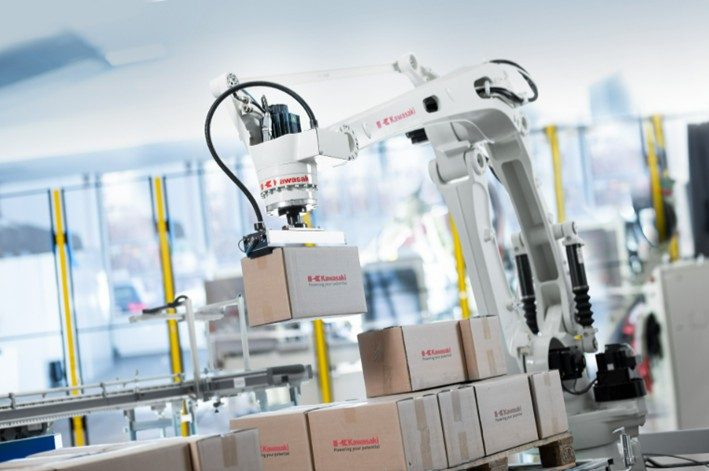
Humanoid robots are not “finished” — the value of Physical AI continues to expand, step by step.
Humanoid robots have attracted attention as a symbol of Physical AI. Since 2015, Kawasaki has been steadily developing its humanoid robot, Kaleido. However, we do not view humanoids as entities that will suddenly transform society.
The widespread adoption of humanoid robots will begin by supporting and complementing human tasks. From there, they will be applied to specific tasks and environments, gradually expanding their roles over time. We believe that this step-by-step social implementation is the most realistic approach.
The key is not to replace all human work, but to design a division of labor in which humans and robots can each make the most of their respective strengths. This is where the true path to implementing Physical AI lies.
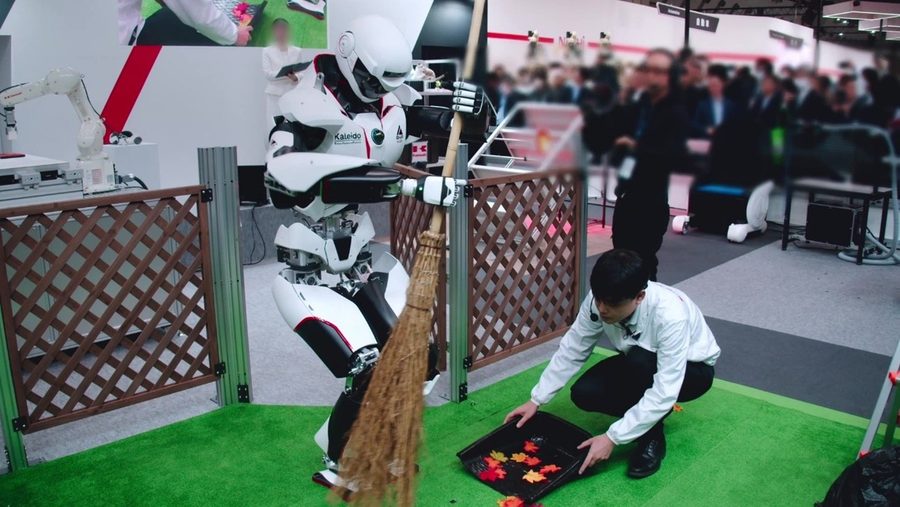
Kawasaki Robotics’ strength lies in its on-site capability.
Kawasaki Robotics places great importance on robots being used continuously in real-world environments. In manufacturing and other demanding workplaces, robots are expected to operate safely, reliably, and without interruption—while maintaining consistent quality.
Over many years, we have worked closely with these sites to refine machinery, control systems, safety, and operation as an integrated whole. This field-oriented approach to manufacturing is one of Kawasaki Robotics’ core strengths, and we see it as the foundation of our competitiveness in the age of Physical AI.
Rather than following the evolution of AI as a mere technological trend, Kawasaki Robotics promotes the implementation of Physical AI from the perspective of how it can directly contribute to solving real-world challenges. Our goal is to create environments where humans and robots can collaborate effectively, leveraging their respective strengths—step by step, at each individual site.
Through the steady accumulation of these efforts, robots will evolve into an indispensable part of society. This is the future of Physical AI, and the next stage of robotics as envisioned by Kawasaki Heavy Industries.