- ApplicationsMaterial Handling
- Robot SeriesduAro series
A pioneer in card printing, aiming to improve productivity through 24-hour operation
You probably have several plastic cards in your wallet for various purposes, such as loyalty cards, membership cards, employee ID cards and medical certificates. Kenbisha Ltd. specialises in the printing of plastic cards.
Kembisha operates a range of websites to suit different purposes, including IDmart, which specialises in ID cards that include a photo and name, iCcard.com, which specialises in IC cards such as Felica and Mifare, and ID Card Self, where data submission and design creation can be completed online. The company’s services are based on the concept of “providing customers with a smooth and worry-free ordering experience”, and have resulted in transactions with more than 12,000 companies, 80% of which are repeat customers.
To raise the five promises and attitudes of customer service to a higher level – promptness, politeness, security, safety and gratitude – we introduced robots from Kawasaki Heavy Industries.
Anticipating the times, we were among the first to introduce online shopping

Ltd. was founded by President Nakata’s grandfather around 1955 as Kemisha Printing Works. Later, his father became independent from his grandfather’s company and established Kembisha Ltd. President Nakata worked for another company after graduating from university, but joined Kembisha when he was 30 years old and has now taken over the company as president.
When he first joined the company, he did not own a printing press and only did sales and outsourced printing. Demand for paper was declining due to the rise of the internet and other factors, and sales were gradually falling, so President Nakata turned to online sales as a way to rebuild.
At the time, internet sales were just beginning to appear on the market, and President Nakata was one of the first to create a website and start online sales. Orders from all over the country increased, and the company introduced a printing machine, albeit a small one, and sales gradually recovered.
Turning the helm to a printing company specialising in card printing
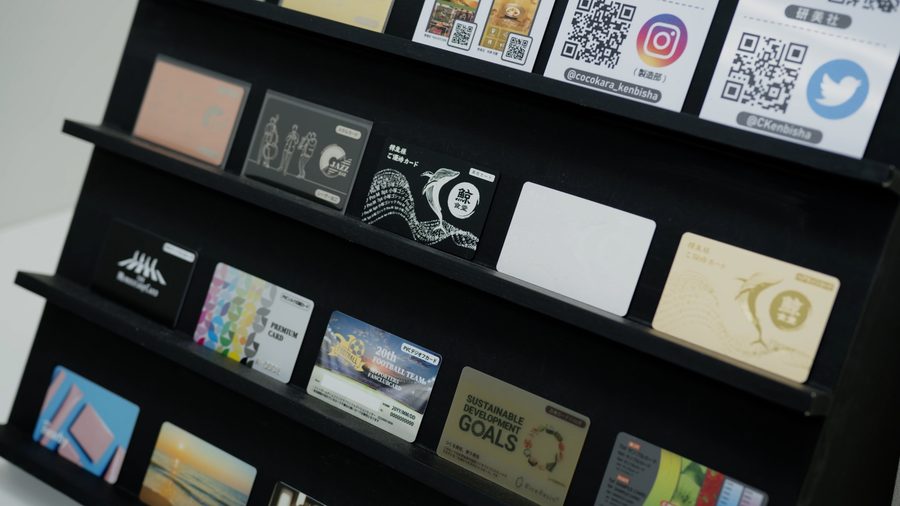
However, while the number of orders increased, work on the small printing presses was not keeping up with the demand, especially during the New Year’s card season, when the company had to work all night every day. The profit margin was low for the amount of labour involved, and in the search for something more efficient and profitable, the company came across plastic cards.
At that time, paper was the mainstream for membership cards, and not many companies were involved in plastic card printing. The company was also quick to adopt online sales, and its high search rankings provided a tailwind that led to an increase in orders, and the company was able to steer its way to becoming a printing company specialising in plastic cards.
Seeking automation for more efficient operations
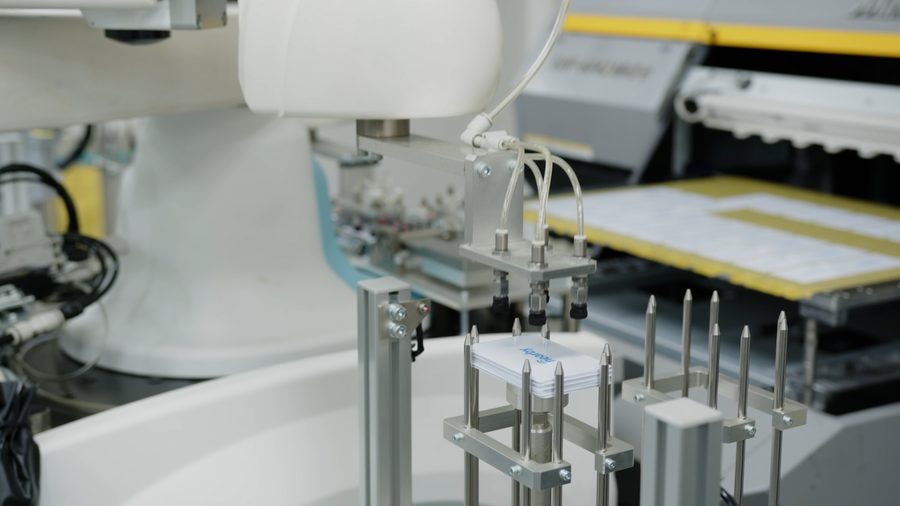
The plastic cards produced by Kembisha are also available in small lots, with many orders for just one card, and as each card is printed with a different design, everything is done manually, from loading the card into the printing machine to collecting the cards afterwards. The printing capacity is 36 cards at a time, which takes about 15 minutes for single-sided printing, and twice as long for double-sided printing, during which time staff are always on hand.
We therefore considered automating the process to make it more efficient so that we could provide customers with more speedy service. However, as he did not know where to turn to for advice on automation, President Nakata went to Machine Auto Co Ltd, a former client of his.
From one arm to two. Achieving both efficiency and miniaturisation
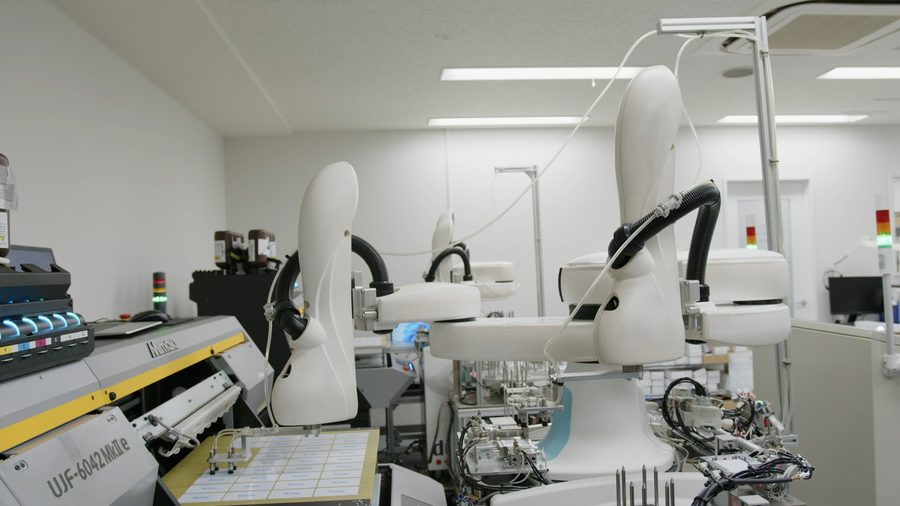
Machine Auto Corporation is a system partner of Kawasaki Robotics, based in Nara Prefecture. The company uses robots, AI and IoT to help improve the efficiency of various operations, and when President Nakata went to consult with them, they suggested introducing robots. The conversation proceeded and the first robot was introduced, but it was actually not a Kawasaki Heavy Industries robot but a product of another company.
The introduction of the first robot reduced the staff’s workload and allowed them to operate outside working hours, but because it had only one arm, there was no significant change in the amount of time spent on a single task. President Nakata then consulted Machine Auto again in search of higher efficiency, and was approached by Kawasaki Heavy Industries about a twin-arm robot.
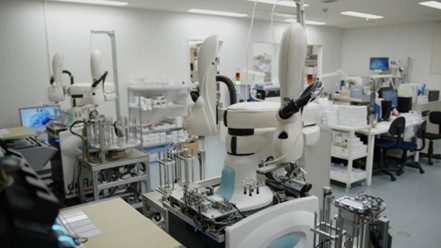
Kawasaki’s dual-arm robot has two arms, so after printing is finished, one arm can collect the cards while the other arm sets new cards, which saves a lot of time. Another deciding factor in the decision to introduce the robot was the fact that, despite having two more arms, the robot itself is more compact than the first machine.
Staff spend their free time creatively
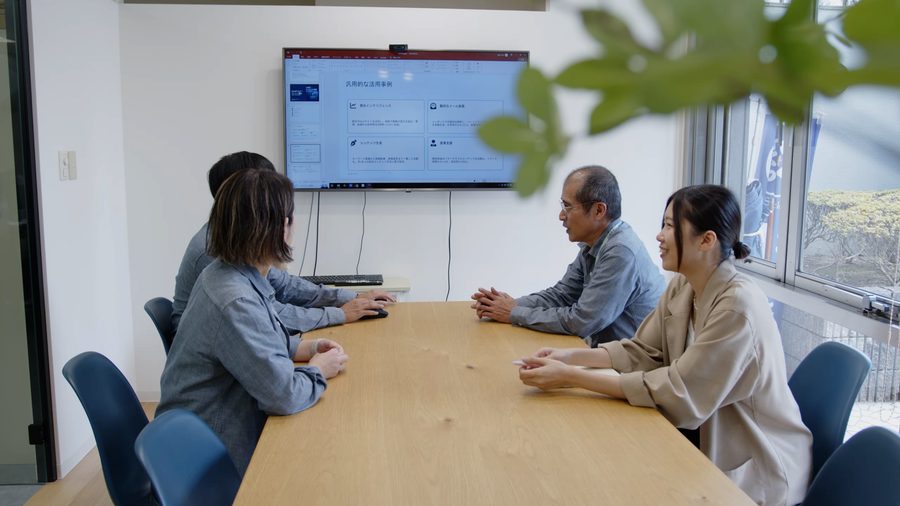
However, immediately after the introduction of the robot, there were many operational failures. The staff were unfamiliar with the machine, but the products they handled were plastic, and slight differences in thickness, warping, static electricity and other factors had a considerable impact on them. As President Nakata says, “Thanks to the adjustments made by the people in charge at Machine Auto Co Ltd, the machine is now running speedily”, and it is now stable, with work efficiency up by about 1.6 times.
In addition to the twin-armed arm, a third machine with equipment to encode information onto IC chips has already been introduced, further improving work efficiency. With the introduction of a fourth machine on track for April 2026, the introduction of robots is essential for further progress. The introduction of robots is essential for a further leap forward.
Evolving robots to raise the bar in the printing industry
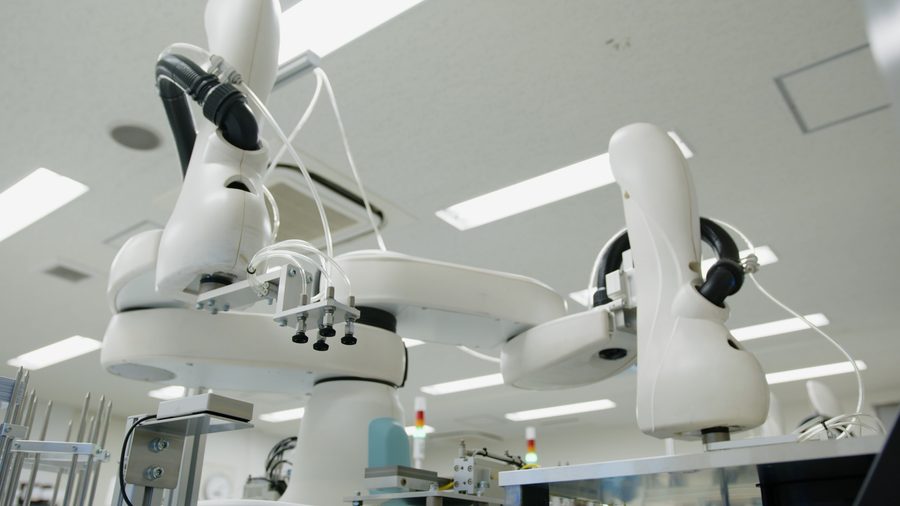
As the introduction of robots is still not common, President Nakata is often contacted by people asking to see his robots. While he gladly accepts tours, President Nakata says: “I want Kawasaki Heavy Industries to share more and more examples of the introduction of robots with the printing industry.
This will encourage more printing companies to introduce the robots, and then they will give us feedback on their opinions. If the robots evolve further by repeating this process, and if interfaces are developed that can be easily operated even by part-timers, a better production environment will be created and this will help raise the level of the industry as a whole.
Related video
Associated Products

duAro1
The Dual-Arm SCARA Robot “duAro” by Kawasaki Robotics:
A brand new offering that realizes the concept of an innovative Dual-Arm SCARA Robot which can safely collaborate with humans in work operations.