

- IndustriesFood & Beverage
- ApplicationsPalletizing
- Robot SeriesCP series
With years of experience designing sophisticated packaging automation systems, the The project group has earned the trust of customers across the food and beverage, hygiene, wood, steel, and construction industries. The company specializes in delivering customized solutions that address unique production requirements, including variable batch sizes and space-constrained facilities.
Those capabilities were put to work for Greinwald, a food manufacturer known for its seasoning mixes, soups, sauces, and dressings. The project came about through a recommendation from J.M. Schmitt, a long-standing customer of the system integrator and supplier to Greinwald, underscoring the strength of established industry relationships and proven automation expertise.
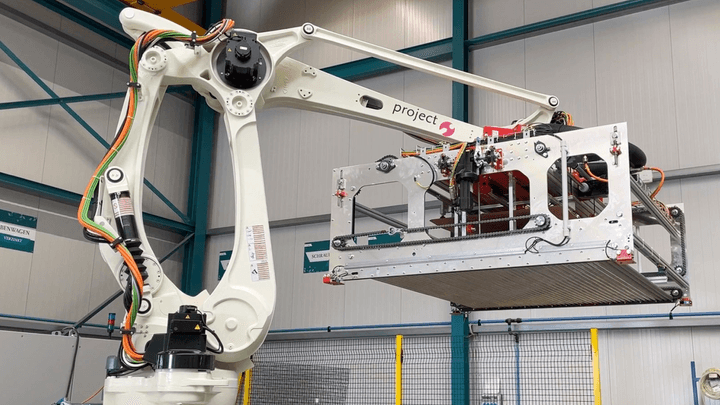
Kawasaki Robotics CP180L at the heart of the automation system
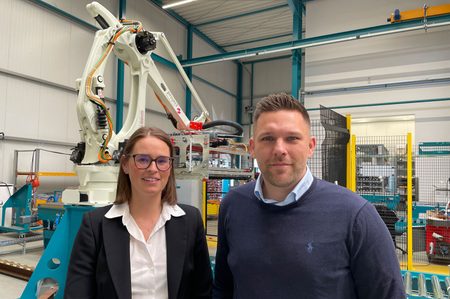
Ella Liversage, Project Manager at Greinwald, emphasized the importance of reliability when selecting an automation partner:
We know that Kawasaki is a pioneer in robotics. For us, the priority is working with a dependable partner that helps us minimize downtime and ensures reliable performance.
The resulting solution combines two identical robotic cells, each powered by a high-speed Kawasaki CP180L palletizing robot. Featuring dual pick-up and feed stations, the modular system maximizes throughput while maintaining the flexibility required for efficient operation in a space-constrained food manufacturing environment.
At the heart of each robotic cell is the Kawasaki CP180L palletizing robot, delivering a maximum reach of 3,255 mm and a payload capacity of 180 kg. Its combination of speed, reach, and performance makes it ideally suited for high-throughput palletizing applications within a compact footprint.
The system is designed to handle cans produced in a variety of sizes, stacking up to 15 layers on Euro pallets with a maximum pallet height of 1,765 mm. From the outset, efficiency was a key project objective, with each robotic cell targeting throughput rates of up to 160 cans per minute and three pallet layers per minute.
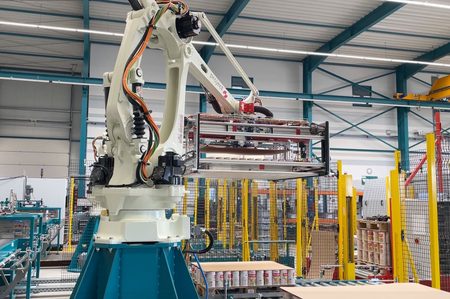
During operation, empty pallets are automatically conveyed from a pallet magazine to one of four palletizing stations. Based on the selected production recipe, the system precisely places either product layers or intermediate layers as required. A custom-designed PROPAL gripper, developed by the project team, provides the flexibility to access all four pallet positions and all four layer tables, ensuring smooth, reliable palletizing across the entire cell.
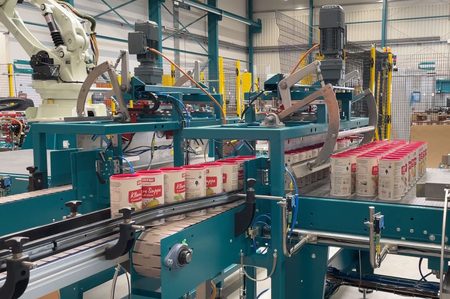
Filled cans are transferred from the staging area into the system, where they are automatically organized into either aligned or staggered layers based on production requirements. Once a pallet is fully assembled, it is conveyed to the wrapping station via a transfer carriage for secure load stabilization. After wrapping, the pallet is ready for downstream handling and shipment.
For applications requiring product identification and traceability, the system can be equipped with the optional PROLABEL pallet labeling solution, developed by the system integrator, which automatically applies the required labels before the pallet exits the cell. This integrated approach helps streamline palletizing, wrapping, and labeling within a single automated workflow.
Modular design creates flexibility
A key success factor of the solution is its modular design, which offers maximum flexibility. If required, the system can easily be extended by two palletizing stations and feeders. Interfaces to adjacent machines enable easy coordination and interlinking of all elements of production. Thanks to the modular design, a third robot can also be integrated in future with minimal effort in order to handle larger production volumes efficiently.
Ella Liversage draws a positive balance: “We are very satisfied with the service from Kawasaki. We have short response times for any inquiries. They are answered promptly, we always have friendly contacts and we’ve never felt left on our own.” Sascha Rosteck, project manager for automation at Greinwald, also agrees: “We were able to successfully implement the project together with Kawasaki. With the two CP180Ls, we were able to effectively meet the specifications of 320 cans and 6 layers per minute.”
Associated Products

CP180L
High-Speed Palletizing Robot
The CP series palletizing robots feature industry leading cycle times, a broad motion range, a space and energy saving controller, and easy-to-use palletizing software for simplified programming. You’ll see our CP series robots supporting end-of-line and distribution processes in a wide range of industries, reducing cycle times and boosting overall efficiency. With the lightest maximum payload capacity, the CP180L model’s throughput is the highest of the CP series palletizing robots,.