
Stop Replacing Automation Every Time Production Changes
For many fabrication and welding shops, automation investments are made around a specific program, product family, or contract. The challenge comes three to five years later when that program ends and a new opportunity arrives with different part sizes, payload requirements, or production volumes.
Unfortunately, most robotic welding systems on the market were designed around a fixed application. When production requirements change, manufacturers often discover that their existing robot cell, positioners, or track systems can no longer accommodate the new work. The result is a costly cycle of replacing equipment that still has years of useful life remaining.
Kawasaki Robotics takes a fundamentally different approach. Through the combination of K-Positioners, K-Tracks, and VeloWeld robotic welding systems Kawasaki delivers a truly modular welding automation platform that can evolve alongside your business instead of becoming obsolete when production changes.
What Is a Modular Robotic Welding Solution?
Most automation suppliers use the term “modular” loosely. In reality, many systems are simply configurable during the initial installation but difficult or expensive to modify afterward.
True modularity means:
- Expanding reach without replacing robots
- Increasing work envelope dimensions
- Modifying positioner configurations
- Extending track lengths
- Adding robot travel axes
- Increasing system height for larger weldments
- Reconfiguring existing assets for new applications
Kawasaki’s K-Positioners are specifically built around a modular construction philosophy, making it easy to modify and adapt systems as production requirements evolve and your customers’ needs change. This design philosophy extends throughout the entire welding automation ecosystem. When evaluating robotic welding solutions, many manufacturers focus exclusively on acquisition cost.
The Hidden Cost of Traditional Robotic Welding Automation
However, the real cost of ownership is determined over the next decade. Consider a fabrication shop that purchases a robotic welding cell to manufacture agricultural equipment components. Four years later, a new customer requires significantly larger assemblies.
With many automation suppliers, the shop may face:
- Replacing the positioner
- Purchasing a larger robot cell
- Installing new robot tracks
- Reworking safety systems
- Rebuilding fixtures
- Investing in entirely new automation
The original equipment may still function perfectly but can no longer accommodate the new application. This creates a second capital expenditure cycle long before the equipment reaches end-of-life.
How Modular Welding K Positioners Protect Your Automation Investment
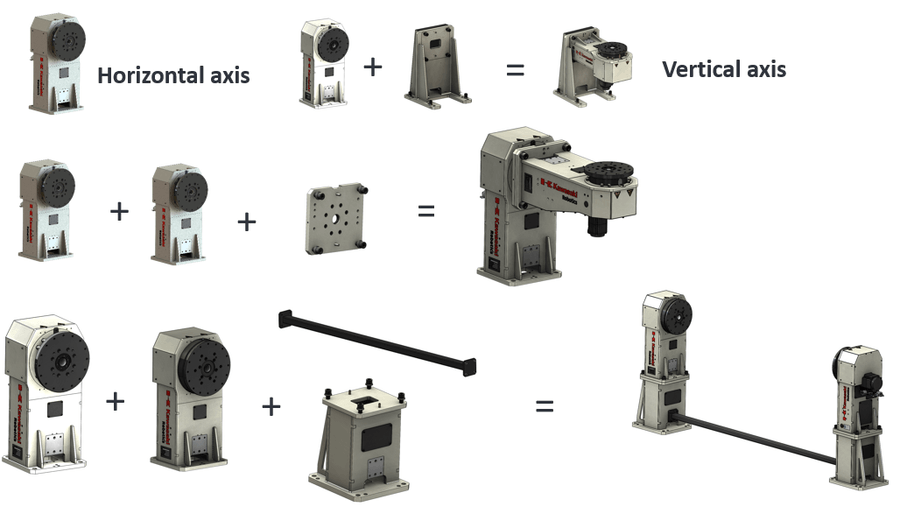
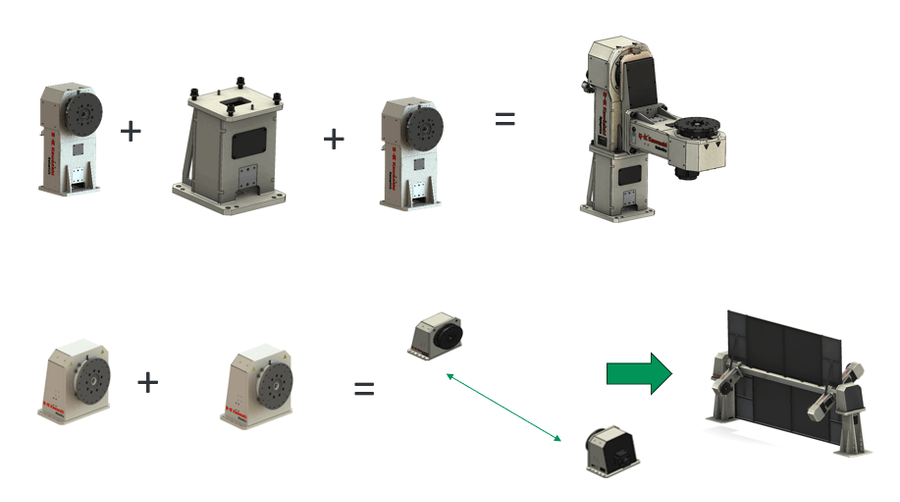
Kawasaki K-Positioners are designed around modular construction principles that allow manufacturers to adapt systems as production requirements change. The product line supports applications ranging from small workpieces to components weighing up to 3,000 kg while offering configurable and customizable designs.
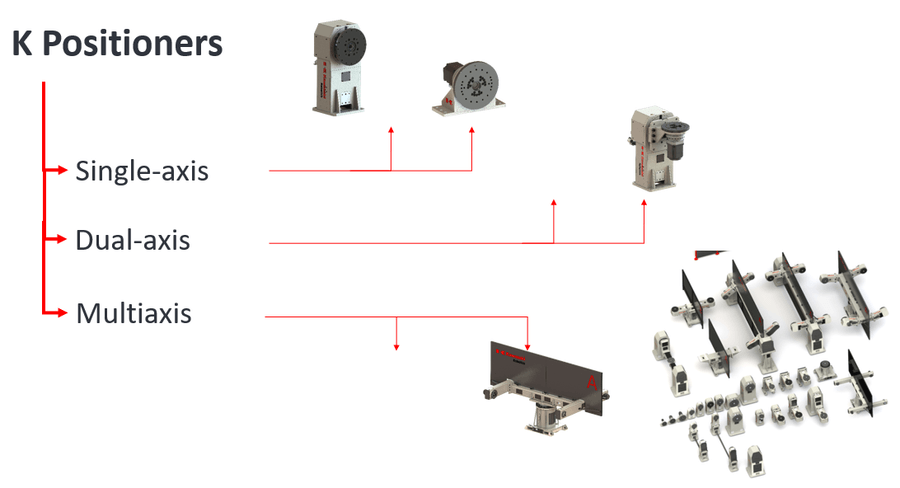
The system includes modular options such as:
- Adjustable spacers
- Multiple axis configurations
- Support units
- Height-increasing pedestals
- Programmable external axes
The ability to increase positioner height and reconfigure system layouts means manufacturers can often accommodate larger weldments without replacing core equipment. Instead of buying a new positioner, customers can modify the one they already own.
How Robot K Tracks Increase Reach and Reduce Automation Costs
One of the most common challenges in robotic welding is work envelope limitations. As parts become larger, manufacturers frequently assume they need a larger robot or an entirely new welding cell. Kawasaki’s K-Track systems provide a more intelligent solution.
K-Tracks extend robot working range through modular linear track systems that can be expanded with additional modules. Kawasaki’s track systems are available in multiple configurations and can be customized for specific production requirements. Certain K-Track models can be extended through modular sections, allowing manufacturers to increase travel distance as needed.
Kawasaki’s K-Track systems provide manufacturers with greater flexibility, lower capital costs, and the ability to adapt to changing production requirements. By extending a robot’s working range, a single robot can service larger parts and multiple work zones, reducing the need for additional automation equipment. Rather than purchasing new robots when production demands evolve, manufacturers can expand the reach of their existing systems, maximizing the value of their original investment.
This modular approach also simplifies redeployment, allowing tracks to be reconfigured for new applications as programs change. As a result, K-Tracks help manufacturers reconfigure production lines more efficiently while reducing the total number of robots required within a facility.
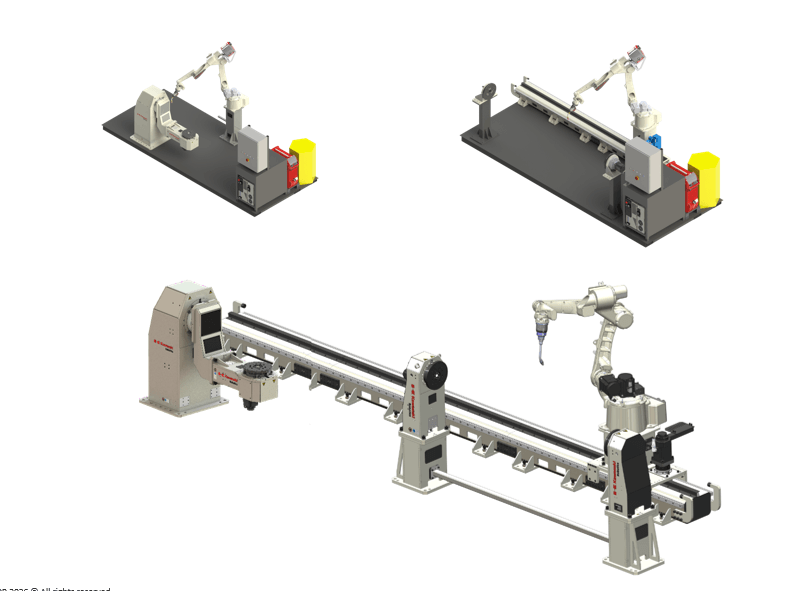
VeloWeld: A Modular Robotic Welding System Designed for Future Growth
In partnership with VeloWeld, a platform was developed to simplify robotic welding deployment while maintaining flexibility for future growth. Rather than forcing manufacturers into a rigid system architecture, VeloWeld combined with Kawasaki robots, K-Positioners, and K-Tracks to create scalable welding automation cells.
As production requirements evolve, customers can:
- Increase system reach
- Add track travel
- Upgrade positioners
- Accommodate larger weldments
- Reconfigure layouts for new products
This approach transforms automation from a fixed asset into a flexible manufacturing platform.
How Modular Welding Automation Improves ROI and Reduces Capital Costs
The largest advantage of modular automation is not technical. It’s financial. When manufacturers can redeploy existing automation assets instead of replacing them, they benefit from:
| Business Benefit | Traditional Welding Automation | Kawasaki Modular Automation |
| Capital Expenditure | Often requires purchasing new positioners, tracks, or complete cells when production requirements change. | Existing K-Tracks, K-Positioners, and VeloWeld systems can be modified and expanded, reducing future capital investments. |
| Return on Investment (ROI) | ROI is often limited to the life of a single production program. | Automation assets continue generating value across multiple programs and product lines. |
| Time to Launch New Programs | Long lead times for new equipment procurement and installation. | Existing systems can be reconfigured and redeployed much faster. |
| Operational Risk | New contracts may require significant reinvestment in automation. | Flexible system architecture allows adaptation to changing production requirements. |
| Asset Utilization | Equipment may become underutilized or obsolete when a program ends. | Robots, tracks, and positioners can be repurposed for future applications. |
| Scalability | Expansion often requires purchasing additional cells or larger systems. | Add track length, increase height, extend reach, or modify positioners as needs evolve. |
| Total Cost of Ownership | Multiple replacement cycles increase lifetime ownership costs. | Modular upgrades reduce replacement costs and extend equipment life. |
| Future-Proofing | Designed around today’s application. | Designed to evolve with tomorrow’s production requirements. |
Future-Proof Your Welding Automation Investment
Today’s fabrication environment is changing faster than ever.
Manufacturers are expected to:
- Handle shorter production runs
- Support greater product variation
- Respond quickly to customer demand
- Manage labor shortages
- Improve profitability
Automation that cannot adapt becomes a liability. Automation that evolves becomes a competitive advantage. That is why Kawasaki’s modular approach to robotic welding stands apart from traditional automation solutions.
With VeloWeld systems, K-Positioners, and K-Tracks, manufacturers gain an automation platform that can be expanded, modified, and redeployed as business needs change. The result is lower lifetime ownership costs, higher automation ROI, and the flexibility to pursue new opportunities without starting over.
That’s not just automation. That’s future-proof manufacturing.