
- IndustriesMachinery & Metal Fabrication
- ApplicationsArc Welding
- Robot SeriesCL Series, BA series
From Bottleneck to Breakthrough – How Digital Fabrication Scaled Production with Robotics. For Digital Fabrication, growth wasn’t the problem, keeping up with it was.
As a family-run metal fabrication shop, the business had built a strong reputation for taking on a wide range of work. From one-off parts to full production runs, their flexibility was their strength. But that same flexibility created a constant challenge: unpredictable demand. Randy Hiebert, co-owner of Digital Fabrication, has led the company’s transition into automation.
At times, the shop was running at full capacity. At others, they were forced to turn work away not because they lacked skill, but because they simply didn’t have the throughput. What followed was a shift that didn’t just improve operations, it fundamentally changed how the business could grow.
At a Glance: Key Results
Before diving deeper, here’s what changed after implementing two Kawasaki BA Series weld robots and a collaborative CL108N weld cobot into their production line:
- Up to 6x faster cycle times
(From ~60 minutes per weld to ~10 minutes) - 4x increase in output on key jobs
(600+ parts completed vs. 150 manually in the same timeframe) - Significant reduction in lead times
(From 10–16 weeks to manageable, competitive timelines) - Increased capacity without linear labor growth
- Shift from turning down work → taking on more high-volume jobs
- Business expansion that led to additional hiring, not downsizing
These weren’t incremental gains; it fundamentally changed how the business operates. And at the source was Digital Fabrication trust in Kawasaki Robotics, as Randy acknowledges, “with Kawasaki, once you buy the machine, they support you for the lifetime of it… that’s been the best part.“
The Challenge: A Business Built for Flexibility, Limited by Capacity
Like many job shops, Digital Fabrication lived in a constant balancing act. When large orders came in, the entire team would shift to keep up. Welders were fully occupied, timelines stretched, and still, it wasn’t enough. At the same time, saying yes to big production jobs often meant saying no to smaller, high-value work. Randy explains, “It took every welder in the shop… and we were still late. We had to start saying no to customers… or push lead times out to 10, 12, even 16 weeks.”
Welding, in particular, became a bottleneck. It was time-intensive, repetitive, and difficult to scale without simply adding more labor and floor space. They had experimented with robotics before, but the experience fell short. At that point, automation didn’t feel like a solution. It felt like another obstacle. “We had no direction… lots of fees… functions locked out. It was very frustrating,” Randy ads.
The Turning Point: A Different Approach to Automation
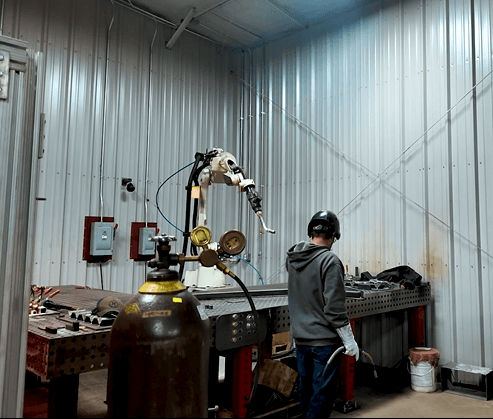
Everything changed when the team decided to give robotics another shot this time with a clearer strategy. Instead of testing automation cautiously, they made a more decisive move: production work would go to robots.
Anything production, we decided it needs to go to a robot.
The robot was doing it in ten minutes… versus an hour by hand.
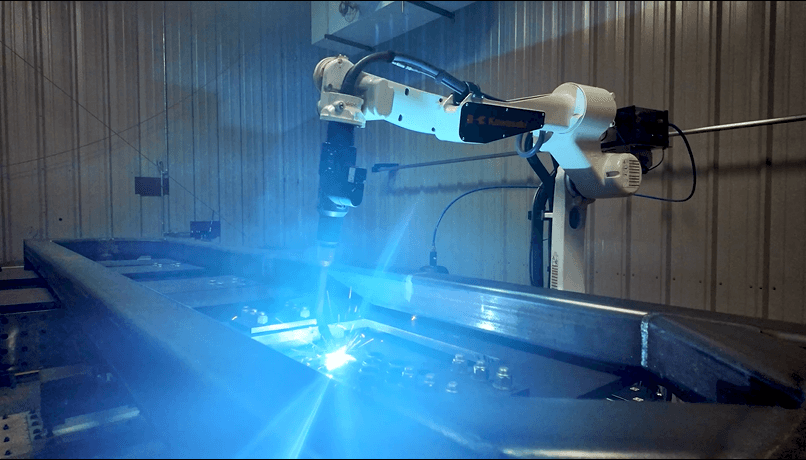
The impact was immediate. A simple welded assembly that took a skilled welder about an hour to complete was suddenly finished in just ten minutes with a Kawasaki BA Series robot. That wasn’t just an incremental improvement, it was a completely different level of efficiency.
Early Wins That Changed Everything
The real proof came during a high-pressure job. With a tight deadline and hundreds of parts to complete, the team decided to put the robot to the test. While one welder had been working on the job for months, the robot quickly caught up and surpassed manual output.
The robot welded 600… the guy had done 150.
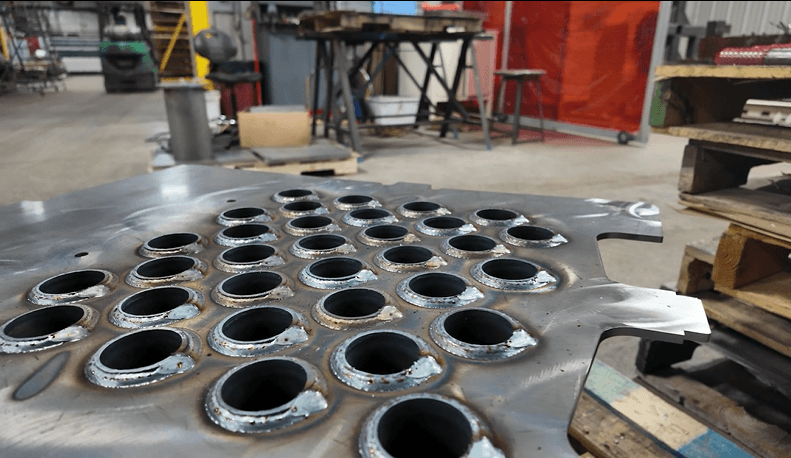
That moment shifted internal perception almost overnight. What started as skepticism turned into momentum. Even the team’s initial concerns about job displacement began to fade. Instead of replacing skilled workers, automation removed the most repetitive tasks, allowing the team to focus on more valuable work. “These robots aren’t going to replace our employees; they make them more efficient,” Randy ads.
Scaling Up: From One Robot to a New Operating Model
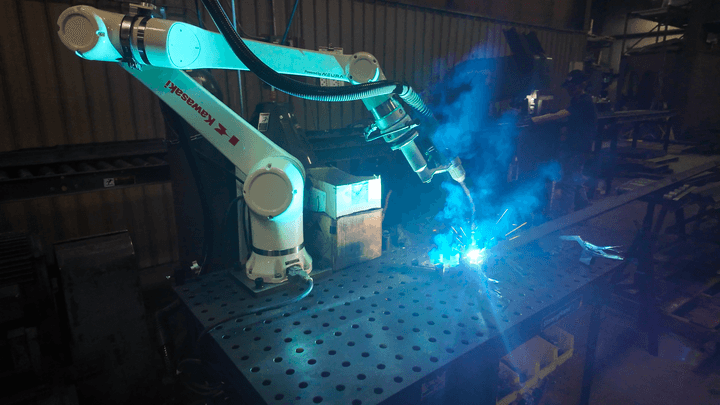
Once the first Kawasaki BA006N robot weld system proved itself, growth accelerated quickly. Within months, Digital Fabrication expanded from a single robotic cell to implementing a second BA006L robot weld system and a collaborative robot weld cart. Each addition unlocked new capabilities. The industrial robots handled high-volume production. While the cobot introduced something equally important: flexibility.
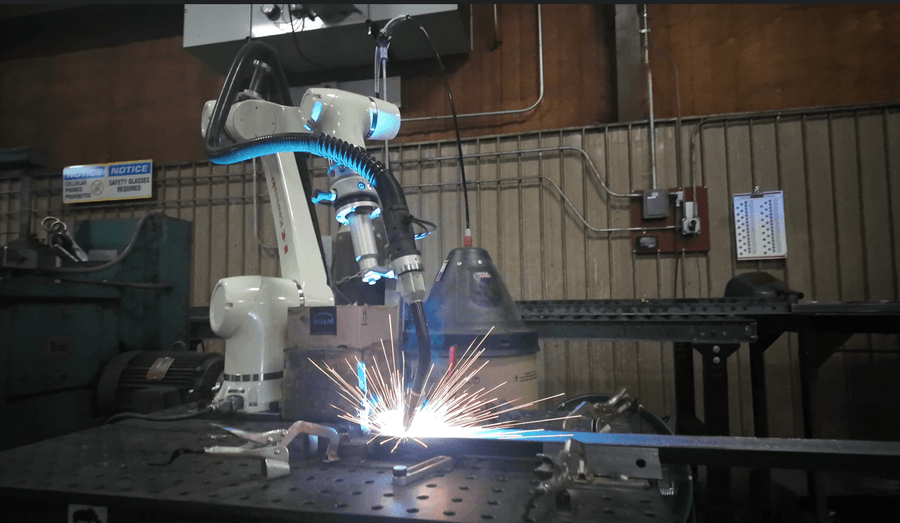
We wanted a robot we could drag around the shop… wherever it’s needed.
The Kawasaki CL108N weld cart provided the flexibility needed to handle large, complex parts that previously disrupted workflow or required manual workarounds. Instead of moving parts to a fixed cell, the robot could now be moved to the part.
The Results: More Than Just Speed
The most obvious impact was speed but the real transformation went much deeper. Production cycles dropped dramatically. Work that once took hours was now completed in minutes, and output increased several times over without a proportional increase in labor. What started as a way to move faster quickly turned into something bigger: a fundamental shift in capacity.
The shop was no longer forced to choose between jobs. They could take on both high-volume production and smaller custom work without compromise. What began as a solution to a bottleneck became a true growth engine. And rather than reducing the need for labor, automation had the opposite effect.
Now we can do a lot more work… we actually are having to add bodies.
With higher throughput came more demand and with more demand came expansion. But just as important as the operational gains was a shift in mindset. At one point, robotics felt out of reach, something reserved for large-scale manufacturers. Today, that perspective has completely changed. Robots are no longer seen as specialized equipment; they’re viewed as essential tools across the entire shop. “I thought robots were only for the big guys… millions of parts a year. I’m now looking to put a robot on every machine in this building,” Randy says.
Digital Fabrication didn’t just speed up welding. They removed a core bottleneck, expanded capacity, and unlocked entirely new types of work. But beyond the numbers, the biggest shift was simple: they moved from reacting to demand… to being ready for it. And for other job shops considering automation, their advice is clear:
The Results:
- Production cycles reduced by up to 6x
- Output increased by 4x or more on key jobs
- Lead times shortened and fewer jobs declined
- Business growth accelerated without major facility expansion
You can’t be half in or half out… you just have to do it.
Application Video
Associated Products
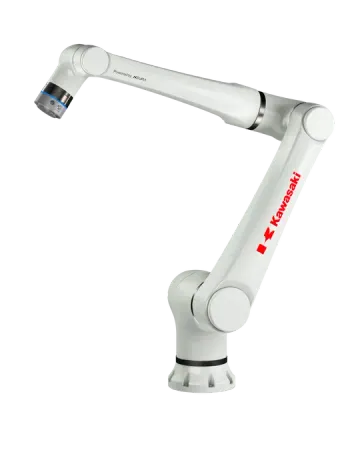
CL108N
No Compromise: The CL Series offers the best of both worlds, with full-on industrial scale performance and speed paired with maximum protection and all the advantages of collaborative robotics. Combined with an intuitive user interface, the CL Series makes automating production lines easier than ever before.
Flexible Line-up: With payloads and reaches of 3kg/590mm, 5kg/800mm, 8kg/1300mm and 10 kg/1000mm, the four models of the CL Series offer the perfect solution for every scenario. Free mounting orientations, extremely small footprints and IP66 classification provide additional flexibility – for all models.
Made for any Use Case and Environment: The CL Series brings together industry-leading speed of 200°/s, and repeatability of ± 0.02 mm for all models. Our collaborative robot line is the perfect choice for automating simple and repetitive tasks – effectively saving costs and maximizing revenue.
State-of-the-art Technology: Designed and built in Germany, the CL Series offers excellent performance through high-quality components, such as the integrated 24-bit encoders, which are among the highest-resolution on the market, and an extremely lightweight yet reliable construction.
Maximum Safety: Its proprietary safety architecture and many features for safety positions, speed, torque, zones, limits and collision detection allow the CL Series Cobots to operate alongside human workers.
Highest Precision: The CL Series can safely handle even the most challenging workpieces and assemble objects with consistent force, eliminating waste and preventing costly collisions.
Well Protected: Thanks to its compact and robust design and IP66 rating, the CL Series can be used in all kinds of harsh environments that may not be suitable for other collaborative robots. Similar to Kawasaki industrial robots, all data and power cables run safely through the robot arm. In addition, dirt can be easily washed off.
Full Connectivity: The CL Series covers common interfaces such as Digital I/O, safety I/O and Ethernet/IP. The TCP connector flange offers digital I/O ports (in/out), analog in ports, and 24V 600 mA power supply.

BA006N
Through-Arm Cable Arc Welding Robot
The BA006N arc welding robot has a maximum reach of 1,445 mm and a hollow wrist structure that allows for easy management of cables and hoses around the torch, providing stable wire feeding and reliable offline teaching. Improve product quality while addressing labor shortages with this high-performance robot.

BA006L
Through-Arm Cable Arc Welding Robot
The BA006L arc welding robot has a maximum reach of 2,036 mm and a hollow wrist structure that allows for easy management of cables and hoses around the torch, providing stable wire feeding and reliable offline teaching. Improve product quality while addressing labor shortages with this high performance robot.