
- IndustriesAerospace, Foundry
- ApplicationsMaterial Handling, Machine Tending
- Robot SeriesZX series
Research on high-tech turbine blades for MTU, Rolls-Royce, and many other partners: The Aachen-based research institute Access e.V. relies on Kawasaki robots in the investment casting process to develop the components of the future
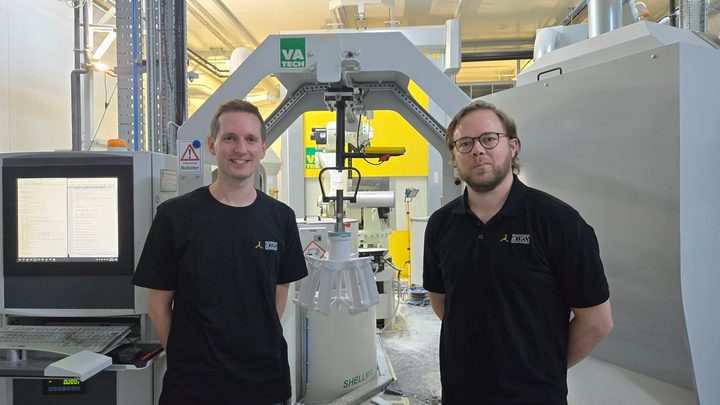
Since its founding in 1986 as a spin-off of RWTH Aachen University, the non-profit, independent research institute Access e.V. has firmly established itself as an innovator in materials research and novel manufacturing processes. At the Aachen TechCenter, casting processes and new materials are developed and validated for a wide range of industrial applications. The focus of the work lies on modern investment casting processes. Renowned partners from the aerospace industry rely on the expertise of Access engineers, including Airbus, Rolls-Royce, and MTU Aero Engines. Due to long process chains with more than 100 steps, investment casting is extremely demanding—especially when developing new component geometries. For more than 10 years, Access has relied on a Kawasaki Robotics ZX130L to execute these demanding projects with precision and speed.
Industry Level Research
Customers and partners do not approach the Access Team for mass production, but rather for research that can be implemented on an industrial scale. “As a general rule, the more complex a component’s geometry, the more likely investment casting is used,” says Martin Hamacher, project manager in automated manufacturing. High-tech processes and complex geometries are increasingly in demand, particularly in aerospace research. Conventional casting processes often reach their limits here—for example, with demanding materials like titanium. “Foundries often approach us when they are unable to handle development projects or need our expertise. We come from a background in prototype development; small batch sizes are part of our daily routine—and close collaboration with industry is essential for us,” says Hamacher. Currently, the comprehensive aviation research project GATE (in collaboration with industrial research partners and funded by the BMWK) demonstrates that automation is the key to meeting the growing demand for complex investment-cast components in the long term.
Access Lays the Foundation for Future Technologies
The components, materials, and processes developed by Access lay the foundation for the technologies of the future. But the path from research to mass production is a long one: despite increasingly accelerated processes, it can take time to reach production readiness. The certification requirements are particularly demanding, for example when it comes to new alloys or new processes in aerospace manufacturing. “Many projects are long-term and build on one another. Of course, not everything will eventually be installed in series-production turbines, but our work is increasingly narrowing the gap between research and industry—and that is always our goal,” explains materials engineer Alexander Küll.
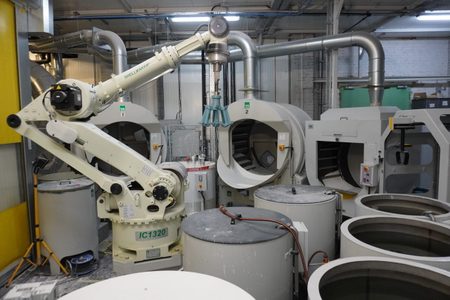
The Robust Heart of Mold Shell Production: Kawasaki Robotics ZX130L in Service for 10 Years
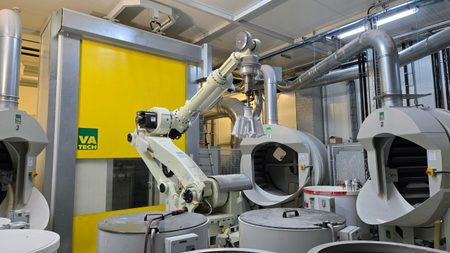
Automation is an integral part of numerous projects: A Kawasaki robot is primarily used in the development of mold systems and casting clusters. Due to their complex geometries and thin wall thicknesses, aircraft engine components—such as those for Rolls-Royce turbine systems—always pose a significant challenge. With a payload capacity of 130 kg and a reach of 2951 mm, the Kawasaki Robotics ZX130L was specifically designed for demanding environments and tasks such as these. Despite its payload capacity and resistance to external influences, the robot is extremely fast, flexible, and has an extensive working range.
The ZX130L has been in use at Access since its introduction in 2014, according to Küll: “With large amounts of slurry and dust, the working environment is extremely demanding. The seals are serviced once a year, but our Kawasaki robot has been running trouble-free for over 10 years—and that’s even without an additional enclosure.” Every project is different: During this time, well over 500 different casting systems and processes have been individually developed and implemented using the robot. The robot, installed by the system integrator VA Tech, serves as the centerpiece of a comprehensive process chain and must be flexibly adapted to the specific requirements of new casting systems. The limited space in an extension of the TechCenter was utilized optimally for this purpose.
AI-Powered Quality Control and Elimination of Deviations
After each shift, the robot feeds the workpiece into an AI-powered camera system (developed as part of the LuFo VI research project FAST), which performs reliable quality control on the surface finish based on collected industrial data. The workpieces are also weighed regularly and automatically to detect deviations. Here, the decisive advantage of automated mold shell production quickly becomes clear: In manual production, the variance in mold shell weight per casting setup consistently shows significant deviations, albeit within acceptable limits. However, robot-assisted production results in a virtually constant mold shell weight with no significant variation.
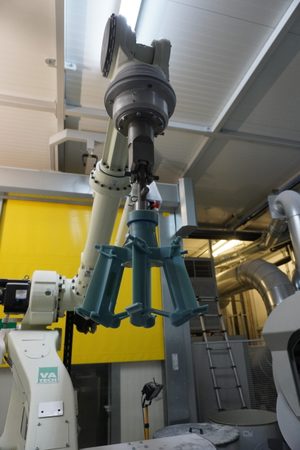
Kawasaki Robots Effectively Reduce Processing Times
A digital twin of the system continuously visualizes the system’s status, reliably alerts operators to errors, and allows for flexible setting of limit values for different workpieces. Due to the high number of shifts and the drying and processing times, manual production of the ceramic molds typically takes over a week. Here, too, the advantages of the robot become clear: By operating continuously, even overnight, processing time is effectively reduced. “Production also places a high physical strain on employees. By using the robot, we can spare them this strain and utilize their expertise in other areas,” says Alexander Küll.
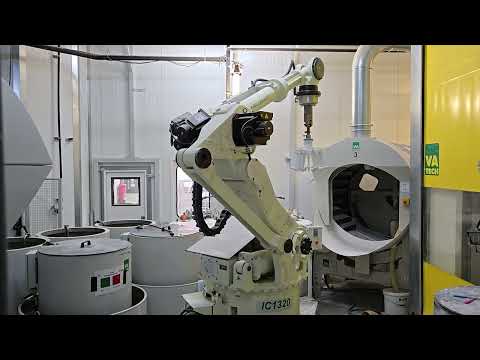
During mold shell production, the robot operates two drying systems, three slip tanks, and three sanding units. The wax parts, which were previously injected individually into molds and assembled into a cluster of models, are fed to the robot via a conveyor system. After the workpiece is immersed in the slip tank, the ZX130L first allows it to drain and then feeds it to a sanding machine, which coats the surface with ceramic sand. The casting cluster is then transferred to a drying system. After drying, this step is repeated automatically according to the desired layer sequence until the sealing layer is applied. Using a laser, the robot is able to detect the exact fill level of the slip tank to select the optimal immersion depth.
Outlook
The Access TechCenter is scheduled to move to the new Production Launch Center Aviation (PLCA) in 2027—a facility specifically designed for the development of state-of-the-art manufacturing processes for safety-critical aviation components. Martin Hamacher and the entire Access team already have numerous plans for the new location: “We have made good use of the space at the TechCenter, but we plan to implement the automation of additional process steps on an industrial scale at the PLCA. Industry-oriented research only works with the right technology—that’s why industry-ready automation is a necessity for us. By optimizing the robot-assisted system, we’re able to make mold shell production with the existing ZX130L even more flexible through additional pots and sanders, and expand the potential working area.”
However, the PLCA also preserves Access’s distinctive research focus, according to Hamacher: “Our goal is not just to conduct research on paper, but to apply it directly to industrial practice. In process development, therefore, it is important not to lose flexibility despite automation. This approach has proven highly effective for us and will continue to form the foundation of our research and development.”
Application Video
Associated Products
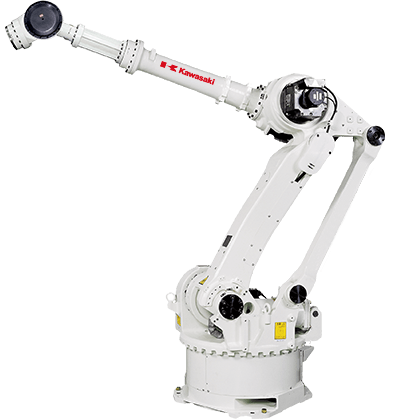
ZX130L
Flexible, Heavy-Duty Robot
The ZX130L robot is a workhorse with a wide working range and long reach. This model is ideal for a wide range of applications, from spot welding to material handling, giving you the flexibility to adapt to the needs of your market.